
Getting on the "Write" Track
Written Expression in Elementary and Middle School Classrooms
Presented by Bayou Education Partners — Dr. Kelly Pizani & Dr. Brandie Wolsefer
White Paper"Each year in their writing, students should demonstrate increasing sophistication in all aspects of language use, from vocabulary and syntax to the development and organization of ideas."— Common Core State Standards Initiative, 2010
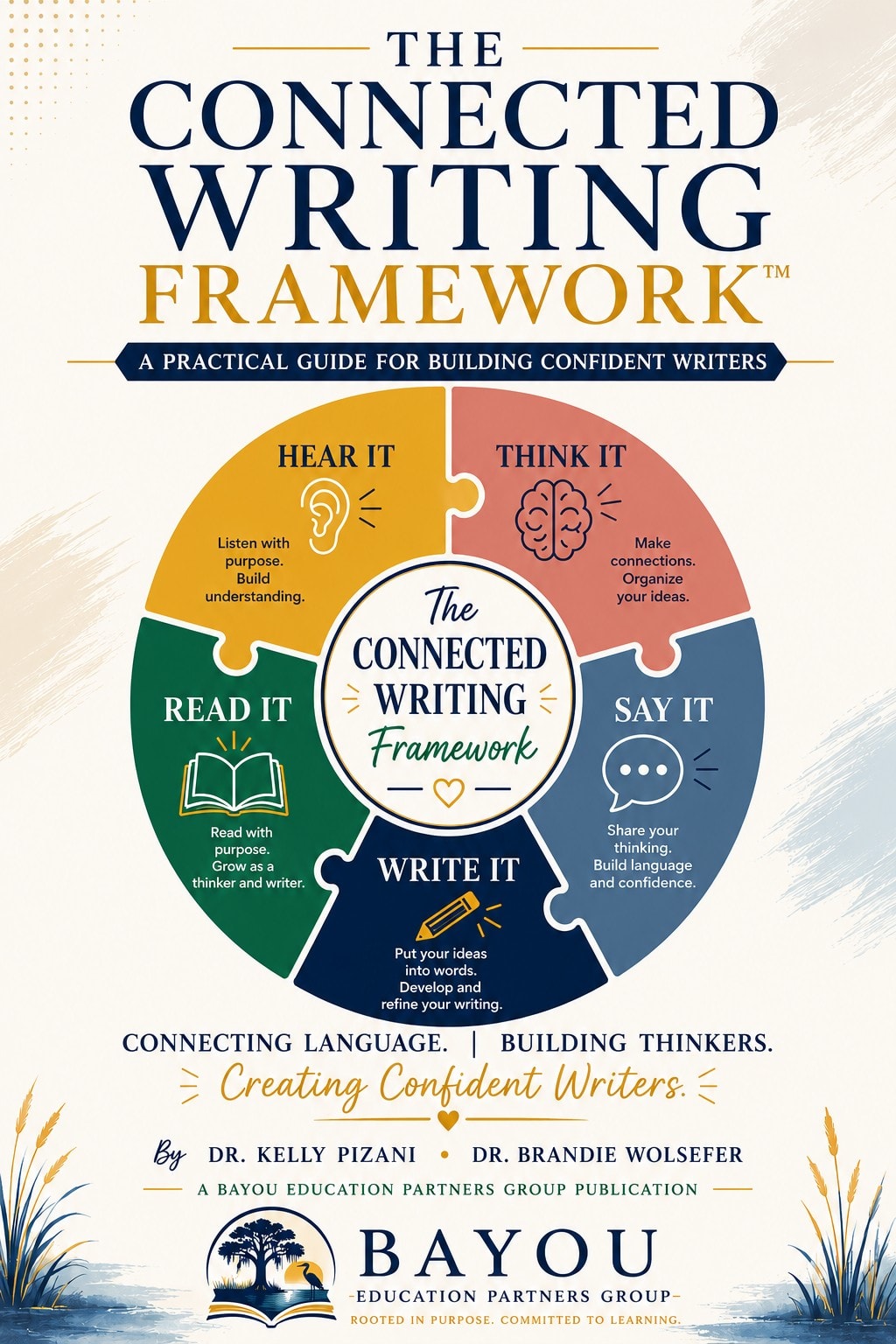
Now available
We now have a published book on our framework
The Connected Writing Framework: A Practical Guide for Building Confident Writers is now available in print and digital formats. Written by Dr. Kelly Pizani and Dr. Brandie Wolsefer, this book brings the full framework to life — giving educators the tools, language, and structure to transform how students think and write.
Purchase the CWF HandbookThe State of Writing Instruction
The Common Core State Standards have been around for over 15 years, and while most states have crafted their own version of the standards, the heart of written expression still lies within the expectations of what students should know and be able to do. The intent is there, but in reality, writing instruction is one of the weakest areas of instruction in most every classroom.
Mississippi mandates 90 minutes of instruction daily in K-8 for the science of reading, and even further provides sample schedules that include a separate 30 minutes of writing instruction. Louisiana has made substantial investments in literacy through statewide science of reading initiatives, literacy screeners, high-quality instructional materials, and professional learning opportunities for educators.
While Louisiana's ELA standards and Guidebooks emphasize students' ability to read, analyze, and communicate their understanding of complex texts, there is less explicit guidance regarding dedicated daily writing instruction and writing-to-learn practices. As a result, the implementation of writing instruction across the state varies across schools and districts depending on local priorities and instructional practices.
Why Writing Gets Deprioritized
If writing instruction is not a priority for states, what happens to the daily instruction? The obvious answer is that writing instruction becomes deprioritized. Even when embedded into the curriculum, writing instruction is often isolated from independent student writings.
Even though educators value writing instruction, they often do not feel confident to teach writing, as many are not adequately prepared and desire more training. Some educators reported having as little as one week of writing instruction in their preparation programs.
The relationship between reading and writing is not one way — writing helps students further internalize their understanding of content. Once students have mastered the basics of learning to read, the shift to reading to learn occurs, but the process should not stop there. Building effective literacy then pushes students to write to learn.
Write to Learn — Not Learn to Write
Writing to learn is an approach embedded throughout the day as a way to make thinking evident — writing is "thinking made visible" (Zinsser, 2013). It is an approach that helps students check their understanding of the content and deepen their understanding in all content areas.
There are many strategies that can be implemented throughout the day across all grade levels: journaling, annotations, word problems, summarizing, and learning logs, to name a few. These strategies can be part of a broader picture to develop written expression crafted to create purposeful written products and leverage children's linguistic and discursive resources.
If we want our students to express themselves in a stronger manner, we need to provide them opportunities to do so, across the school day in support of learning. Students can only express what they have thought about, and can only think about what they have been given the opportunity to do.
The Connected Writing Framework
Unlocking the Puzzle of How Students Write Successfully
The Connected Writing Framework was developed to address a persistent challenge in schools: students are often expected to demonstrate complex thinking through writing without receiving systematic instruction in how ideas move from comprehension to communication. Rather than viewing writing as a stand-alone subject or a collection of isolated skills, the Connected Writing Framework positions writing as a process of thinking.
Build knowledge through reading, listening, modeling, and exposure to content
Organize, analyze, connect, and process ideas
Rehearse language and clarify understanding through discussion
Communicate thinking through authentic written expression
Reflect, revise, evaluate, and deepen understanding
The framework is applicable across grade levels, content areas, and student populations, including students with disabilities, multilingual learners, emerging writers, and advanced learners.
Putting Writing Back at the Center of Learning
The challenge facing educators is not whether students should write more; it is how they can create systems that intentionally integrate writing throughout instruction. Schools need practical approaches that help educators embed writing across content areas so that students move beyond learning how to write and instead use writing as a tool for learning.
Putting writing back into schools does not require another program or initiative. It requires a shift in how educators view writing: not simply as a skill to be taught, but as a vehicle for learning. The Connected Writing Framework provides that pathway, helping schools move from teaching students how to write to empowering them to write in order to learn.
Writing should not be reserved for the end of a lesson, a weekly prompt, or a state assessment. Writing should be woven throughout the school day as a tool for thinking, processing, and communicating understanding. When students are given opportunities to hear, think, speak, write, and reflect, they become more than proficient writers — they become stronger learners.
Share your voice
We want your thoughts on writing
Your experience as an educator shapes everything we do. Take a few minutes to share your perspective on writing instruction — it helps us continue building tools that truly serve teachers and students.
Take the SurveyReady to bring the Connected Writing Framework to your classroom?
Purchase the CWF handbook and start transforming writing instruction in your classrooms.
Purchase the CWF Handbook